
Let dots be themselves
Koga Miura
2026年 5月 27日
ー
6月 28日
SOM GALLERY
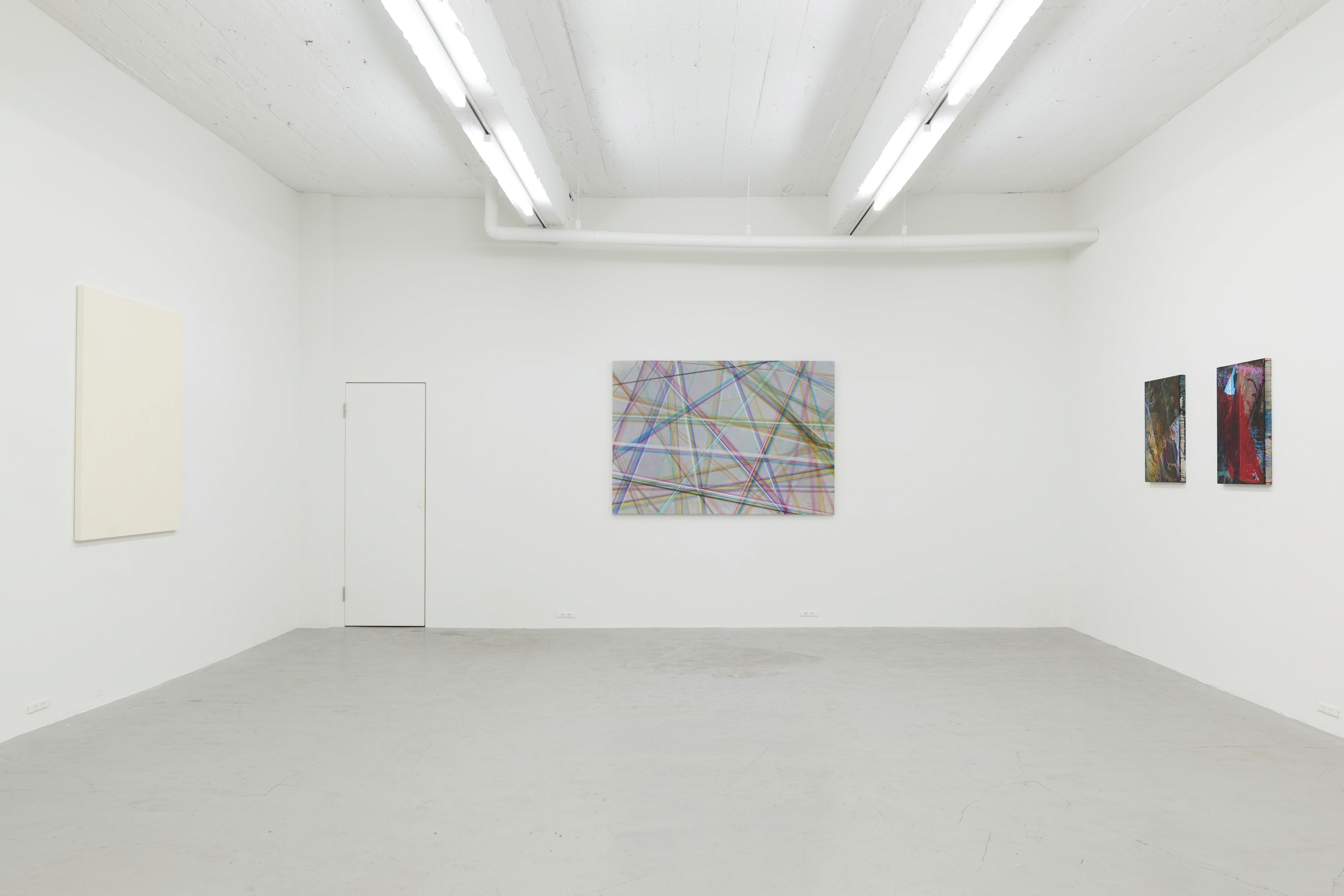
SOM GALLERY is pleased to announce “Let dots be themselves”, a solo exhibition by Koga Miura, on view from May 27 through June 28. Through a new body of work, the exhibition begins with a simple question: how does painting come into being? Rather than seeking an answer, it attests to what persists within the act of making and what remains, as the process unfolds.
Born in Yamaguchi in 1997, Miura completed his MFA in oil painting at Kyoto University of the Arts in 2021. His practice engages with chance, indeterminacy, the boundary between manual and mechanical processes, and the conditions of labor, primarily through two-dimensional works. By constructing images according to instructions derived from random numbers, he minimizes subjective decision-making, allowing the work to emerge through the execution of a given procedure. At the same time, Miura is attentive to the subtle variations that arise within repetition itself, reconsidering how perception operates in the face of the seemingly uniform.
In Miura’s work, drawing is no longer about the need to compose or to express, but to carry out a set of predetermined actions. Lines are drawn between points determined by chance, and the same gesture is repeated over time. Yet this repetition never resolves into sameness. Slight tremors of the hand, the viscosity of paint, the resistance of the surface are all contingencies that inevitably intervene. What appears on the canvas is thus not a fixed image but the accumulation of duration: a layered record in which structure and deviation coexist. The work holds its own originating system and the traces of its undoing, at once.
Such an approach recalls the practice of John Cage, who relinquished the act of choosing sounds through chance operations, shifting the artwork from something made to something that occurs. Underlying this shift is a disposition often associated with Zen: a letting go of intention, an openness to what arises. What is relinquished is not simply choice, but the will to choose. In this sense, the role of the artist is reconfigured not as the origin of meaning, but as the one who establishes the conditions under which events may take place.
Miura’s practice shares this structure, yet diverges in a crucial way. Where Cage opened the field of sound as a temporal event, Miura situates his work within the material surface of painting. Even as his process follows a protocol determined by chance, its execution remains irreducibly uneven. Each line appears with slight differences -bleeding, blurring, shifts in density- creating harmonic tension between order and contingency. The same action is repeated, yet no result is ever identical.What comes into view is what persists after intention has been set aside.
In contrast to contemporary image generation through AI, where processes are accelerated, automated, and largely concealed, Miura’s work moves in the opposite direction. By adhering to a procedure, he simplifies the act of making, while allowing the duration of execution, the presence of labor, and the involvement of the body to remain visible. These elements are not eliminated; they accumulate.
What remains when one follows a predetermined procedure? If Zen accepts what arises, and Cage opens it as an event, Miura receives it as the trace of repeated action. At a moment when artistic production is increasingly relegated to algorithmic systems, this exhibition quietly asks what it means for something to remain and what it means for human involvement to persist through time, through labor, and through the ever-waking hand.
Works
Installation View
